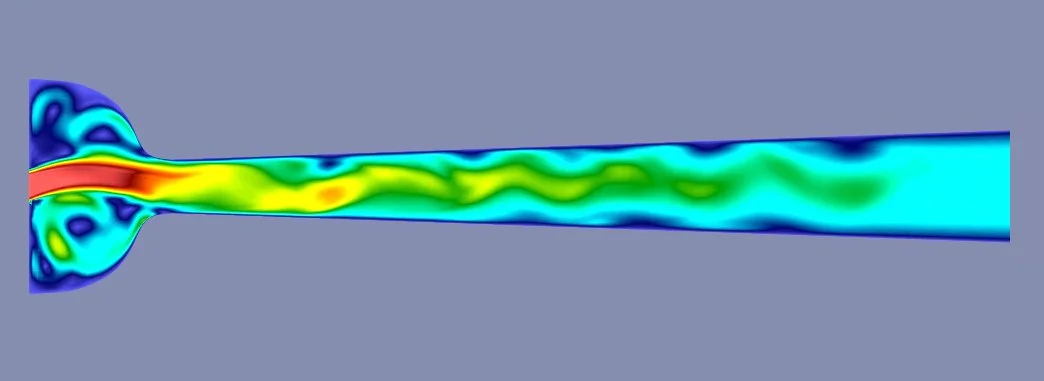
Turbulent Coherent Structures in Aerophones
One investigative focus of my research in musicology is on transient processes of aerophones and the question how sound is created in this class of musical instruments.
Trans-sonic phenomena in brass instruments
Tran-sonic phenomena in brass instruments are particularly relevant during the initial transient and overblowing. Rapid changes in lip aperture and pressure can produce local airflow conditions beyond the speed of sound, influencing excitation, mode transitions, and tone quality.
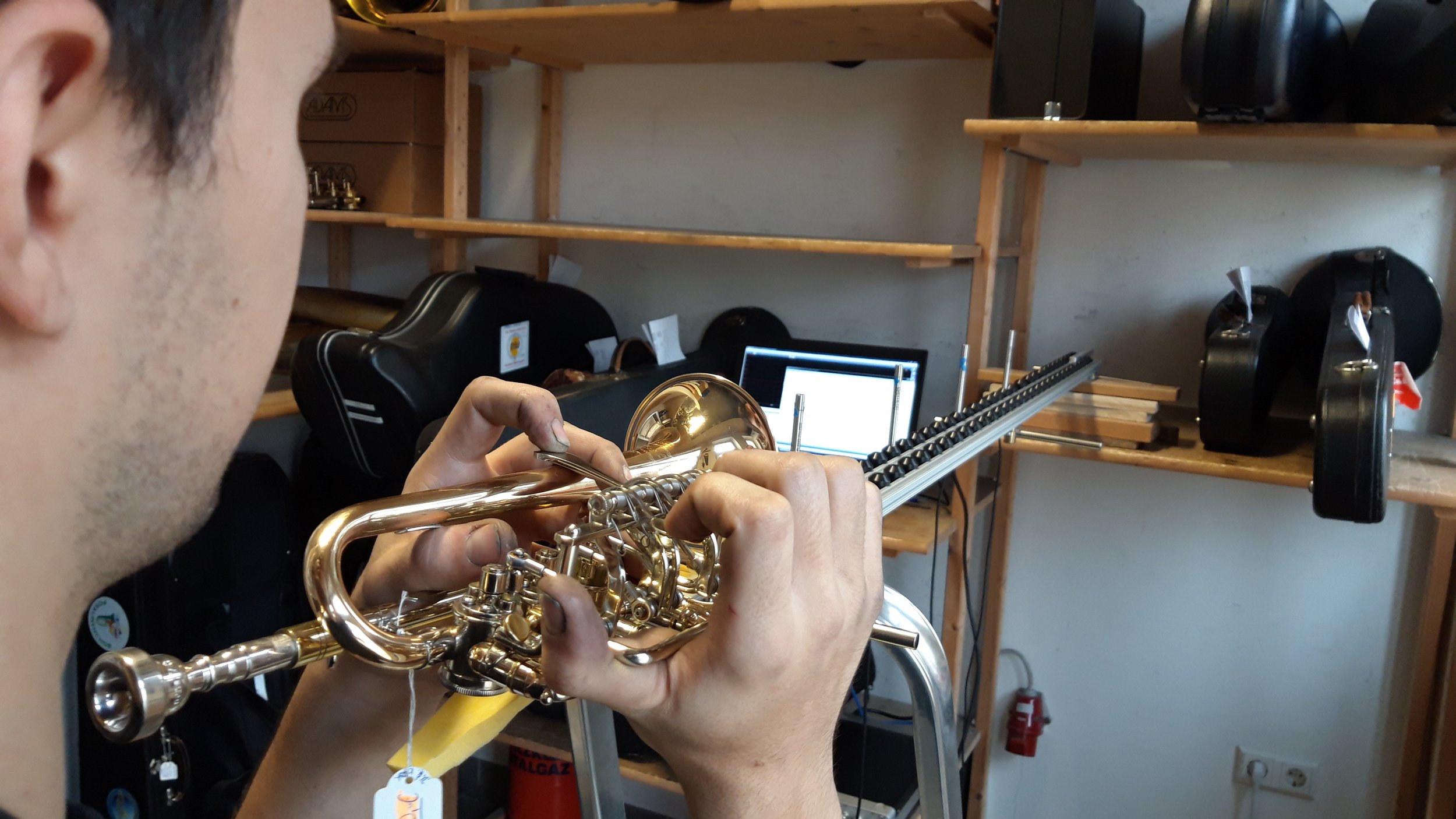
The time evolution of the sound pressure in a trumpets mouthpiece can be measured but the setup is hard to realized. With numerical simulation you can dive much more deeply into the complex interplay of periodical wind forcing by the musician and sound generation inside the instrument.
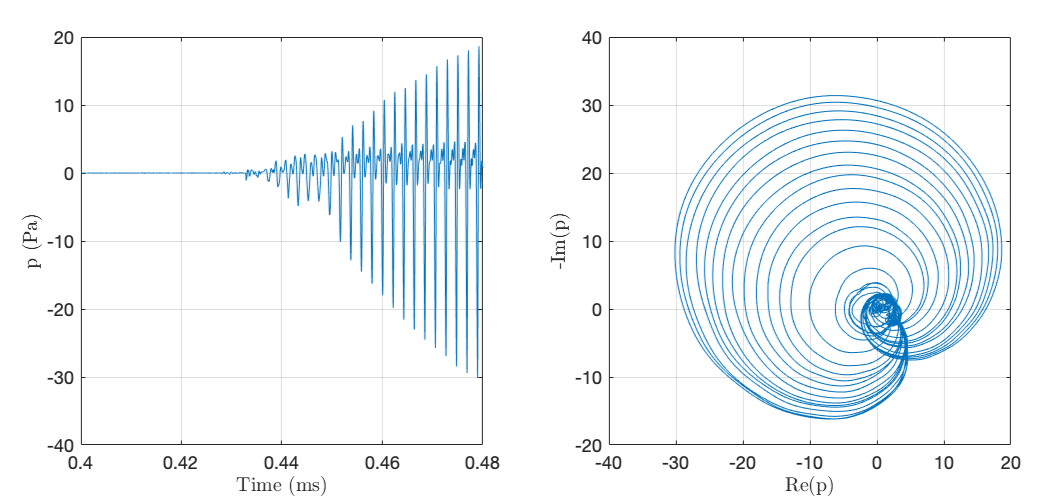
Initial transient of a trumpet
Brass instruments can produce trans-sonic phenomena, which means that the sound pressure moves a little faster than sound speed. This shock wave characteristics is the result of the players technique and the specific construction of the mouthpiece, the cup.
The time evolution of the sound pressure in a trumpet mouthpiece during the initial blowing transient follow a complex nonlinear dynamics. The figures show the evolution of sound pressure in time and the corresponding phase-space portrait, revealing the evolution of the phase trajectory. From a chaotic initial state, a complex dynamic develops, sustained by energy input from the player, and gradually establishes the fundamental mode. The formation of the first and higher (un)harmonic loops is also visible. The system synchronizes and approaches a limit cycle corresponding to the instrument’s operating mode.